
TL;DR: Most teams guess what customers value. Conjoint analysis replaces instinct with evidence by revealing how buyers make real trade-offs between various possible price points and features, supporting smarter product design, pricing, and go-to-market decisions in both B2B and B2C markets.
Before launching a new product, most teams spend extensive time debating which features to incorporate, why, and how to price the product. All too often, though, these debates are based on instinct, anecdotal evidence, and personal bias. Sometimes this works. Often it doesn’t.
Enter conjoint analysis. Engaging directly with target customers is the best way to make informed product and pricing decisions, and conjoint represents one of the best ways to go about doing this. Instead of asking customers what they like in theory, conjoint analysis reveals what they actually value when trade-offs are unavoidable.
Despite its utility, a recent study found that only 25% of product managers and researchers were familiar with conjoint analysis—and just 30% of those had run a study in the past year. So let’s dig in.
What Is Conjoint Analysis? A Practical Breakdown
Choice-based conjoint analysis, often referred to as CBC, is a market research technique used to simulate the actual purchasing experience, where you have to make trade-offs between multiple product attributes, such as price, appearance, extra features, service levels, performance, or contract terms. In short, conjoint analysis provides a way to understand what people care about most when they can’t have everything at once.
How Choice-Based Conjoint Analysis Works
In a choice-based conjoint analysis survey, survey respondents are shown 2-3 hypothetical product options at a time, each with a different set of attributes, and asked to choose their most preferred option. Rather than evaluating attributes in isolation, respondents make a series of choices, selecting between different product options multiple times.
By running each respondent through a number of these choices and analyzing a large volume of responses, we can assign a utility score to each attribute and determine the optimal combination of attributes. As such, conjoint is ideal for determining which attributes should be incorporated into a product or offering to maximize market share.
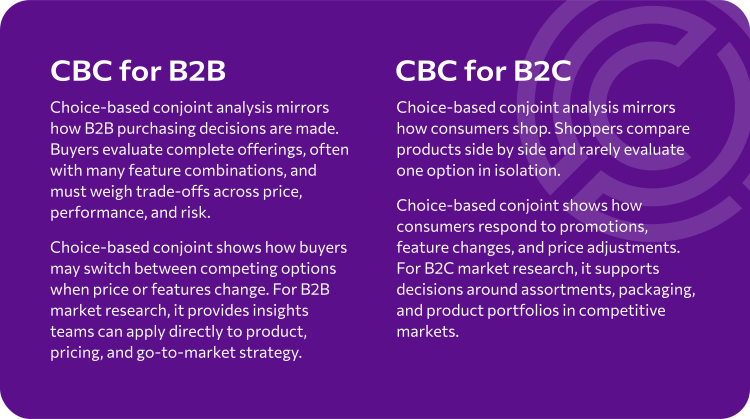
Why Conjoint Analysis Works for B2B
B2B purchasing decisions involve, on average, 13 stakeholders, each bringing different priorities to the table. Some focus on ROI and cost, others on risk and long-term growth potential. But it’s never possible to be all things for all people, so trade offs are inevitable.
Conjoint analysis is designed for exactly this kind of complexity. Think of the survey respondents as a large group of purchasing stakeholders. The right screening criteria ensures you’re gathering feedback from target buyers. Then, by forcing these respondents to make choices across multiple attributes at once, it mirrors how buying committees actually evaluate options and reveals what buyers value most and what they’re willing to give up.
Because price and ROI influence the final decision for 65% of B2B buyers, conjoint analysis is especially powerful. It quantifies willingness to pay for specific features or performance levels, enabling smarter product, pricing, and go-to-market decisions.
Why Conjoint Analysis Works for B2C
B2C decisions also involve trade-offs, even when purchases appear simple on the surface. Consumers regularly balance price against features, brand, convenience, appearance, and perceived quality.
Conjoint analysis works for B2C because it reflects shelf-level and online decision-making. It captures how small changes in price or features can shift preference, helping brands fine-tune offerings before launch. For organizations managing portfolios, SKUs, or tiered offerings, conjoint studies provide clarity on which combinations drive choice and which add unnecessary complexity.
Insights You Can Gain from Conjoint Studies
Conjoint analysis delivers more than just an optimal combination of attributes. It provides a wealth of attribute-level data to inform product decision making. Specifically, it helps teams answer five critical questions.
- Attribute Importance: Conjoint analysis tells us how important each product attribute tested is to customers when they make a purchasing decision, denoted with a utility score. This helps teams focus investment on what matters most.
- Willingness to Pay: When price is included as an attribute, and various pricing options are tested, conjoint analysis measures how sensitive customers are to price and how much they’re willing to pay for specific features or service levels.
- Ideal Product Bundle: Conjoint analysis helps us determine the best possible combination of attributes that would maximize likelihood of purchasing the product for the greatest number of decision makers.
- Preference Share: uses the utility scores to predict the hypothetical market share of a product option. It simulates a competitive marketplace where various configurations of a product are competing, and uses respondent preferences to determine what % of decision makers would likely choose a product with one specific option vs. a product with other options.
- Competitive Advantage Insights: When brand is included as an attribute, and various competitors are included, conjoint analysis reveals how important brand name is in the context of making purchasing decisions and which brands are more preferred than others.
How to Conduct Market Research Using Conjoint Analysis
Effective conjoint analysis requires thoughtful design and disciplined execution. Each step plays a role in the quality of the outcome.
- Step 1: Identify Buyer Roles & Decision Makers: Identify the screening criteria you should build into your survey to ensure the people taking the survey resemble your target buyers. In the B2B space, this may involve screening people based on their industry, company size, job title, and purchasing power. In the B2C space, this can involve factors such as demographics (e.g., age, household income) and behaviors (e.g., past purchase in a particular category).
- Step 2: Define the Right Attributes & Levels: In a conjoint survey, attributes are the various product categories or characteristics that will be tested (e.g., brand, price, color) and levels are the options within each attribute (e.g., Dove, Dial, Irish Spring; $1, $3; white, blue). It is critical to balance the number of attributes and levels given your sample size and desired survey length. Including too few or too many attributes and/or features can comprise the methodology.
- Step 3: Design the Conjoint Analysis Survey: Be sure your survey includes the right screening criteria and the attributes and levels you’ve aligned on. Keep respondent cognitive load in mind when designing the survey. Make the level descriptions you use in the conjoint clear and grounded in familiar language. Avoid technical jargon that distracts respondents from making meaningful choices.
- Step 4: Field Among Prospective Buyers: Sample quality is critical to B2B and B2C. This starts with the right screening criteria, but given the prevalence of survey fraud, it must also involve very careful data monitoring and cleaning while fielding.
- Step 5: Analyze the Results: This is the fun part! Your analysis will reveal utility scores, an optimal product combination, and more. These outputs form the foundation for strategy.
- Step 6: Turn Insights Into Product Strategy: Insights only matter if they lead to action. Use conjoint results to update product roadmaps, tailor messaging to what matters most, and guide pricing and packaging decisions.
Real-World Applications: How Conjoint Analysis Drives Success
Product Development & Innovation
Conjoint analysis aligns engineering priorities with customer value. It shows which features influence choice, helping teams separate must-haves from nice-to-haves. This reduces wasted effort, speeds development, and focuses investment where it delivers return.
Conjoint analysis also supports early-stage innovation by testing feature combinations before development begins. Teams can avoid building ideas that look good internally but fail to drive preference in the market.
Pricing Optimization
Conjoint analysis can directly inform pricing decisions. By measuring price sensitivity in the context of real trade-offs, it reveals what customers are willing to pay when price is weighed against other attributes.
Teams can use these insights to design products at a price point that will maximize revenue potential.
Service Design
Conjoint analysis can also clarify which service elements matter most. It can identify which support features influence purchase and retention, and which add cost without changing behavior.
This helps organizations invest in service levels that customers value while making intentional trade-offs between cost and customer experience.
Go-to-Market Strategy
Conjoint analysis sharpens go-to-market strategy by clarifying value drivers. It reveals which attributes most influence choice, helping teams position offerings around what matters most.
Conjoint studies can also be designed to work in concert with previous segmentation studies to show how different customer groups value different combinations of attributes, enabling more focused offers, messaging, and sales strategies.
Why Work With a Market Research Agency for Conjoint Studies
Conjoint studies are can be extremely challenging to pull off for non-experts. There are a few reasons for this:
- Expert Survey Design: Survey design is always critical (“garbage in, garbage out”), but with conjoint studies in particular this is the biggest determinant of success. Working with a good market research agency ensures you’re using the best possible screening criteria, including the right number of attributes and levels, using the best possible language for each, and structuring the actual conjoint in a way that will produce strong data.
- Experienced Data Modeling: Advanced statistical techniques like conjoint analysis require expertise. Correct interpretation of outputs eliminates poor decisions and prevents overconfidence in misleading results.
- Better Sample & Research Governance: A strong market research agency like Campos will ensure only real, qualified decision-makers participate. We conduct extensive data cleaning while fielding, using a multi-flag system, to eliminate spam, bots, and unqualified respondents, protecting data integrity.
- Strategic Implementation Support: A strong research partner focuses on turning insights into action, not just data dumping. Agencies help align cross-functional teams around customer value and support implementation across product, pricing, and marketing.
Conjoint Analysis FAQs
Here’s a quick recap of what we’ve covered and how conjoint analysis is used in practice.
- What’s conjoint analysis in market research? Conjoint analysis is a quantitative market research method that measures how people value different attributes of a product or service by forcing trade-offs between options.
- When should a company use choice-based conjoint analysis? Choice-based conjoint analysis is ideal when decisions involve multiple attributes and realistic trade-offs, such as pricing, feature prioritization, and competitive positioning.
- How do you conduct a conjoint analysis survey? A conjoint analysis survey presents respondents with 2-3 hypothetical product options at a time, each with a different combination of product attributes, and forces them to pick their most preferred option. In aggregate, these choices reveal attribute importance and the ideal combination of attributes to maximize market share.
- What are the benefits of hiring a market research agency or specialist? Agencies provide expert survey design, advanced modeling, high-quality sample, and strategic guidance that ensures conjoint analysis leads to data-backed decisions.
Build Products Customers Truly Value
Conjoint analysis bridges the gap between assumptions and reality. It provides quantifiable, reliable decision data that reflects how choices are actually made. When done well, conjoint analysis helps organizations design better products, smarter pricing, and more resonant messaging.
Ready to understand what your customers actually care about? Get in touch.