
Brand architecture is like the plumbing in a house: When it’s working, no one even thinks about it. But when there’s a leak—when sub-brands start diluting a parent brand’s equity or customers can’t understand how brands relate—the damage can get messy and expensive fast.
All too often, brand architecture, that is, the framework that defines relationships between a company’s parent brand and its sub-brands, is something organizations ignore. As the organization grows, it launches new products or service lines that take on their own brand identity without much thought on how that identity relates to the parent brand. Over time, the organization launches more sub-brand products or services, perhaps acquires other entities, and suddenly the “brand family” looks less like a cohesive unit and more like a group of strangers in a crowded elevator.
While it’s always best to manage your organization’s brand architecture proactively, there are two moments when it becomes mission-critical:
- The Post-Acquisition Pivot: You’ve just brought a new company into the fold. Do you keep their name? Slap your logo on it? Or create something entirely new? Without a framework, you risk killing the very equity you just paid to acquire.
- The Rebrand or Brand Refresh: You’re evolving. But as you contemplate updating your parent brand’s positioning, you realize your sub-brand strategy can no longer be neglected. If they don’t move with you, they become dead weight.
Why Brand Architecture Matters
Think of brand architecture almost like an org chart that defines the hierarchical relationship between your parent brand and various sub-brands. There are several different brand architecture options an organization can pursue–more on that below–but all are designed to:
- Differentiate an organization’s various offerings within the marketplace.
- Establish where and how the brands will transfer equity (e.g., loyalty and perceived quality) between one another.
- Minimize market confusion by establishing clear boundaries for each brand’s “permission” to play in specific categories.
When this framework is fuzzy or ill defined it creates internal friction. Teams fight over budgets, resources are wasted on overlapping marketing, and—most dangerously—the market gets confused.
Getting Strategic About Your Brand Architecture
It’s one thing to come to the realization that you need to be more strategic about your organization’s brand architecture. It’s another to know what the right brand architecture decision is for your brand.
Generally, your strategy will fall into one of the four buckets below, though hybrid models are increasingly common.
- Branded House: The parent brand is the hero. All sub-brands or services lead with the masterbrand name (think FedEx or Virgin), leveraging maximum equity from the top down.
- Sub-Brands: These brands are connected to the parent but have their own distinct identities (think Apple iPhone or Sony PlayStation). They carry the parent’s “DNA” but cater to specific niches.
- Endorsed Brands: These are independent brands that are “brought to you by” a parent brand (think Courtyard by Marriott). The endorsement provides a “seal of quality” without the brands being twins.
- House of Brands: The parent company remains invisible to the consumer, while the individual brands stand entirely on their own (think P&G or Unilever). This is ideal when brands serve wildly different audiences or price points.
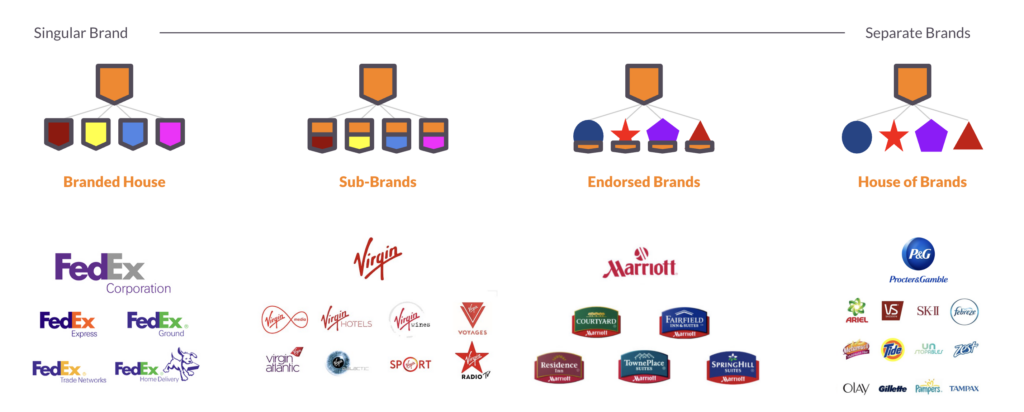
There are opportunities and risks associated with each of these options, and there’s no one option that always works best in a particular category. However, there is typically a best option for your organization–it just takes some insight and strategy to get there.
How to Determine the Right Brand Architecture for your Organization
Deciding which path to take isn’t a “gut feel” exercise—it’s a research problem. Conducting research is the only way to validate whether your parent brand has the “permission” to move into a new category, or if a sub-brand is actually stronger standing on its own. It moves the conversation from “what we think” to “what we know.”
Look Inward
Before you can make any decisions about how to change or update your brand architecture, you need to start with a clear understanding of where you are and how you got there. How many brands are in play? How is each brand positioned and what equities are associated with it? And how does each brand reinforce the organization’s mission, vision, and values? The answers to these questions—or the inability to answer them—will help identify gaps in information that need to be filled.
Fill the Gaps
Once you’ve identified those gaps (e.g., Which sub-brands have the most recognition in the market? How are the sub-brands perceived?) you need to go about filling them with research. The methodology will differ from organization to organization, whether it’s a competitive audit, a market survey, or large-scale employee engagement. The one constant is the need to structure your research with the end goal in mind: Gaining a full understanding of the risks and benefits associated with each brand architecture option so you can make the best decision for growth.
Make a Call
Once you understand the pros, the cons, and the risks associated with each option, you need to make an informed, strategic decision about which to pursue based on what’s realistically achievable for your organization and how the organization intends to grow. This often requires careful engagement of internal stakeholders so they understand what you’ve learned and why you believe one option to be the best. Gaining stakeholder feedback and, ultimately, buy-in can be time consuming, but it’s essential to landing in a place that everyone agrees is the right one for your organization.
Build the Framework
Your end result shouldn’t just be a pretty chart. You should build out a Brand Architecture Framework document explaining your brand architecture and the research foundation it’s built upon. This document also typically includes details on your identity system, meaning the visual and verbal standards that signal your brand relationships to the world—from logos to naming conventions.
Once completed, this document should be provided to internal teams (think brand management, marketing, sales, and product development) and serve as your North Star for future growth, ensuring that every new venture adds to your equity rather than draining it.
Finding the Right Partner to Update Your Brand Architecture
Many organizations don’t have the internal bandwidth or the objective distance required to conduct this level of research and strategy. That’s where an outside partner comes in.
At Campos, brand research and strategy is our bread and butter. We have extensive experience designing custom studies for B2B and B2C organizations seeking to update their brand architecture, and a track record of delivering strategic frameworks that drive growth.
What’s more, our interests lie solely in designing and executing the best possible project to help you arrive at the right architecture. Unlike full-service agencies, we don’t offer “downstream” services like creative execution or media buying. This means we aren’t worried about selling you a specific marketing campaign later—we are purely focused on the strategy that works for your business.
Ready to bring some logic to your brand family? Reach out to us and let’s talk through your options!