
Here’s a hard truth: the market doesn’t care how much time you spent developing a product.
It doesn’t care about your internal roadmaps, your team’s passion, or how revolutionary your leadership team thinks a particular feature is. The market only cares about whether your product solves a real problem, at the right price point, and reaches them with a message that resonates.
Too often, brands treat market research like a single box to check right before a product launches, and they end up trying to cram countless research questions into a single research engagement. Other times, brands neglect to conduct any market research at all before launching a product, basing things like targeting, messaging, and pricing on nothing more than instinct and vibes (yikes!). It’s those brands that find themselves scrambling to engage prospective customers once a product launch isn’t going as planned. But waiting until just before launch (or crisis) to ask buyers what they think is an expensive gamble.
At Campos, we don’t view market research as a box to check on the road to launching a product. Instead, it’s an ongoing, collaborative engine designed to surface product and feature ideas, build products that people actually want to buy, and launch products in a way that maximizes their potential. In other words, product market research helps you make smarter, better decisions at every stage of your product roadmap.
Here is how strategic market research powers high-performing product teams through five stages of the product lifecycle—and how you can leverage research to drive better performance for your brand.
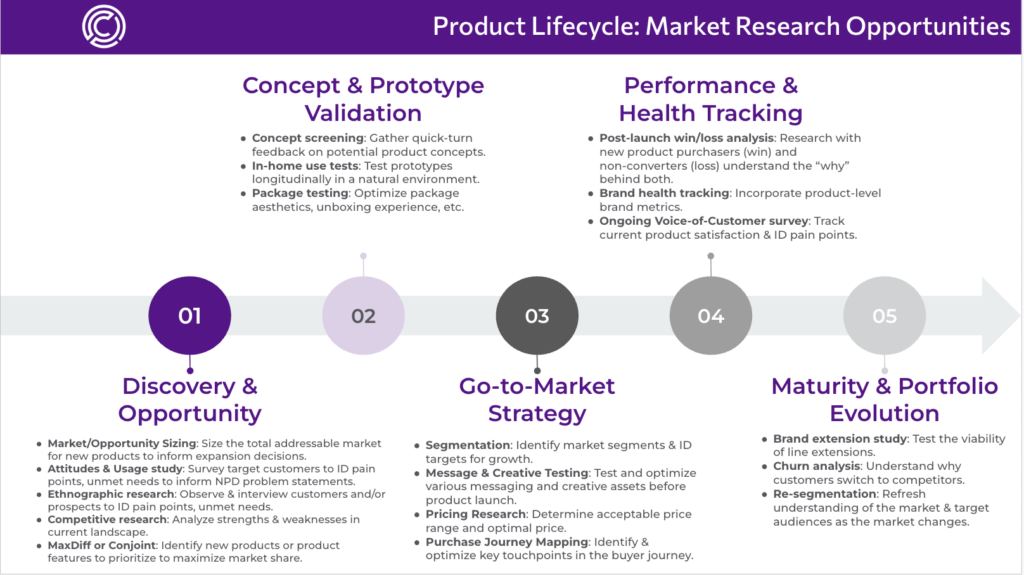
1. Discovery & Opportunity: De-Risk Before You Build
The most expensive product mistake you can make is developing something nobody actually wants. Before a single dollar goes into product development, research helps you identify unmet needs, evaluate the competitive landscape, and prioritize the exact features that will drive conversion.
Key Opportunities at Stage 1:
- Market/Opportunity Sizing: Size the total addressable market for new products to inform expansion decisions.
- Attitudes & Usage study: Survey target players to identify pain points and unmet needs to inform new product development problem statements.
- Ethnographic research: Observe and interview customers and/or prospects to identify pain points and gaps in the experience.
- Competitive research: Analyze strengths and weaknesses in the current landscape.
- MaxDiff or Conjoint: Identify new products or product features to prioritize to maximize market share.
The most successful product teams don’t build new products based on intuition. They leverage market research early on and throughout the development process to ensure their product roadmap reflects the needs and wants of their market.
Case-in-point: Campos recently partnered with a multinational manufacturer on foundational research to inform the development of one of its next-gen marquee products. We used a conjoint study to determine how to prioritize product features while balancing customer preferences with willingness to pay.
2. Concept & Prototype Validation: Test Reality, Not Just Theory
Once you have a defined direction, you’ll need to validate the direction or prototype before you pour millions into developing products at scale. This isn’t about looking for executive confirmation; it’s about exposing your concepts and prototypes to the friction of reality before scaled production.
Key Opportunities at Stage 2:
- Concept screening: Gather quick-turn feedback on potential product concepts.
- In-home user testing: Test prototypes longitudinally in a natural environment.
- Package testing: Optimize package aesthetics, the unboxing experience, etc.
Concept validation isn’t simply a red light/green light exercise (though that’s part of it). It’s also an opportunity to optimize and refine your product before expensive manufacturing commitments are locked in.
In one recent example, we shipped a consumer product to target users for a 2-week user test. By collecting feedback on everything from unboxing to first use to the change in experience over time, we were able to make product optimization and go-to-market recommendations.
3. Go-to-Market Strategy: Aligning Messaging, Price, and Path-to-Purchase
A great product with the wrong positioning, bad pricing, or fractured distribution will fail. Stage three transforms validated products into commercial successes by optimizing how you enter the market.
Key Opportunities at Stage 3:
- Segmentation: Define distinct market segments based on shared behaviors, attitudes, etc. and identify targets for growth.
- Message & Creative Testing: Test and optimize various messaging and creative assets before product launch.
- Pricing Research: Determine both the acceptable price range and optimal price point.
- Purchase Journey Mapping: Identify & optimize key touchpoints in the buyer journey.
Launching without testing your GTM strategy is like driving blindfolded. Data-backed pricing, messaging, and journey mapping reveal the levers that convert interest into revenue before you spend a dime on ad buys.
One of our favorite types of go-to-market projects is a segmentation study. In one recent example, we helped an entertainment venue grow visitation by segmenting their market based on shared attitudes and behaviors, and building out robust profiles and personas to inform targeting.
4. Performance & Health Tracking: Understanding the “Why” Behind the Numbers
Once a product is launched, you’ll have a steady stream of transactional data showing you what is happening with sales, but it will never tell you why. Post-launch research gives context to sales data, helping you double down on wins and fix leaks quickly.
Key Opportunities at Stage 4:
- Post-launch win/loss analysis: Research with new product purchasers (win) and non-converters (loss) to understand the “why” behind both.
- Brand health tracking: Benchmark and track overall reputation of and satisfaction with your brand, as well as satisfaction with particular products and likelihood to repurchase or recommend.
- Ongoing Voice-of-Customer survey: Track current product satisfaction and identify pain points.
Transactional dashboards tell you what happened; post-launch research tells you why. Knowing the rationale behind a purchase or drop-off lets you fix friction points before they eat into your retention metrics.
In our brand health research, we go beyond simple benchmarking and tracking to identify the emotional and rational attributes that most drive category engagement, giving you ongoing insight into how to market your products.
5. Maturity & Portfolio Evolution: Reigniting Growth
Markets evolve, trends shift, and competitors adapt. When a product reaches maturity, strategic product teams shift their focus to maximizing customer lifetime value and expanding portfolio reach.
Key Opportunities at Stage 5:
- Brand extension study: Test the viability of product line extensions.
- Churn analysis: Understand why customers switch to competitors and how you can win them back.
- Re-segmentation: Refresh understanding of the market & target audiences as the market changes.
Maturity isn’t the end of a product’s lifecycle—it’s the cue to evolve. Re-evaluating customer churn, brand extensions, and shifting market segments keeps your portfolio relevant while putting your brand back on an upward growth trajectory.
Not Just Market Research.
All of this research is only useful if you have someone doing the heavy lifting of wading through the data to surface product opportunities and threats. That’s where we come in.
At Campos, we don’t leave you to sift through the data we collect and attempt to make sense of it. Instead, we highlight key findings and their strategic implications. Then, we lead workshops and brainstorm sessions to help product teams go from “what we learned” to “what we can do next.”
Ready to Elevate Your Product Strategy?
Whether you’re exploring a new opportunity, refining a launch strategy, or defending market share in a mature space, we’re here to help. Want to talk products? Reach out.